.webp)

Analysis of the Global Applied AI Agent Market in 2026: Capitalization Dynamics, Growth Leaders, and the Architecture of Enterprise-Scale Deployment
The global market for applied AI agents (Agentic AI) in 2026 is undergoing a phase of deep structural transformation, shifting from isolated pilot projects toward end-to-end automation of business processes. According to market estimates, the size of this segment has grown from $7.63 to 7.84 billion in 2025 to a projected $52.62 - 53.2 billion by 2030. This corresponds to a compound annual growth rate (CAGR) exceeding 45%. Over the longer term, according to Grand View Research, the market could reach $182.97 billion by 2033, with a CAGR of 49.6% between 2026 and 2033.
Capital flowing into this sector demonstrates a high level of concentration. During the first four months of 2026 alone, companies developing agentic systems raised $2.66 billion across 44 investment rounds, more than double the amount raised during the same period the previous year ($1.09 billion). Against the backdrop of total global corporate AI investment reaching $581.7 billion in 2025, applied AI agents are rapidly becoming the dominant category in enterprise software.
Key Growth Leaders and ARR Dynamics
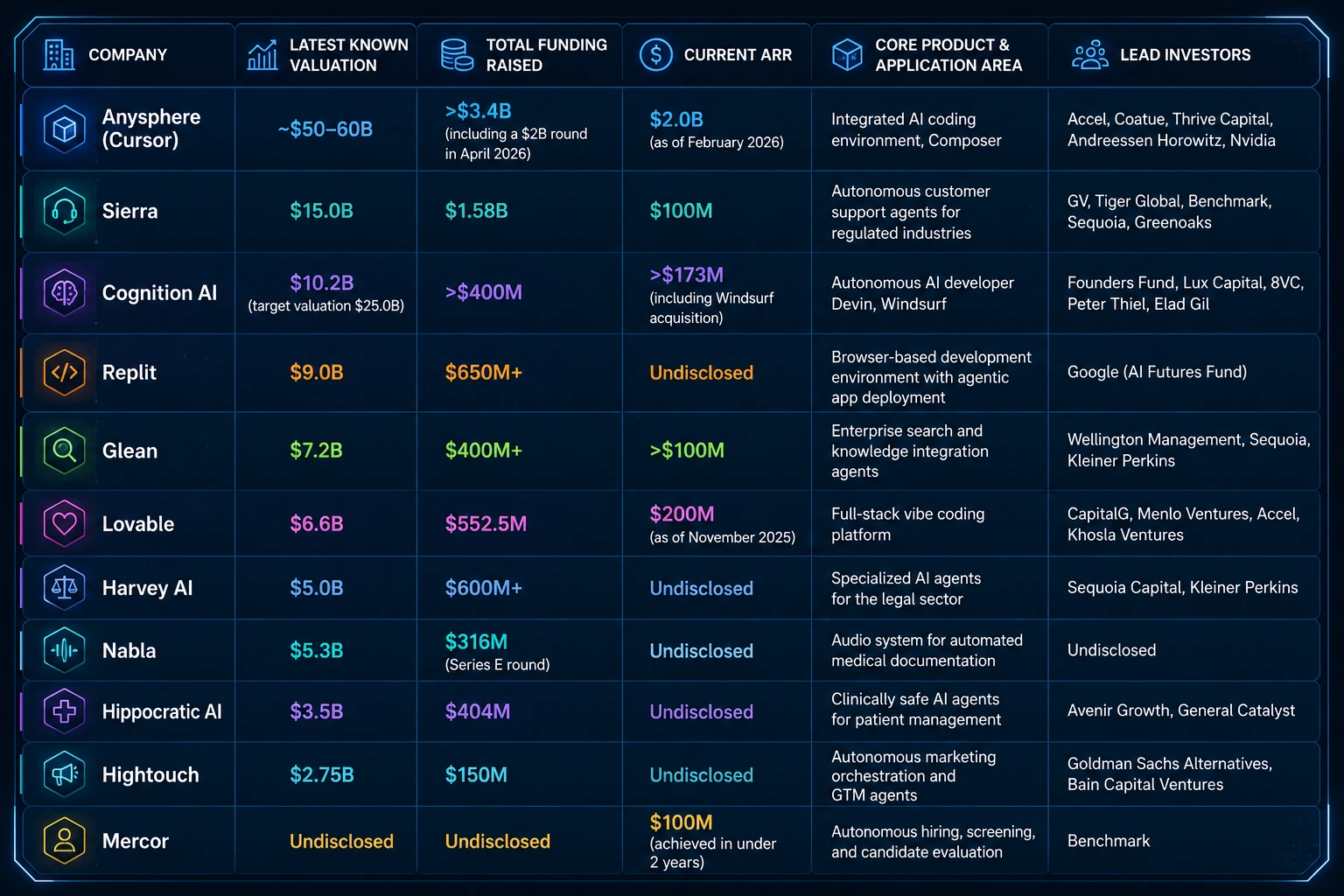
The strongest scaling dynamics are demonstrated by companies focused on software development automation and orchestration of complex workflows. The absolute leader in revenue growth among enterprise software developers is Anysphere (operating under the Cursor brand). In November 2025, during a $2.3 billion Series D round, the company achieved a valuation of $29.3 billion after surpassing $1 billion in annual recurring revenue (ARR). By February 2026, its ARR doubled to $2 billion. In April 2026, the company entered the final stage of negotiations for an additional funding round of at least $2 billion at a $50 billion valuation, led by Andreessen Horowitz and Thrive Capital. An additional confirmation of Anysphere’s strategic value came through an agreement with aerospace company SpaceX, which obtained the right to acquire the startup for $60 billion within a year.
Anysphere’s aggressive revenue growth was driven largely by a change in its infrastructure cost structure. In November 2025, the company deployed its own inference model, Composer, optimized for code generation. Prior to that, all user requests were routed through third-party commercial platforms, primarily Anthropic and OpenAI, which significantly reduced gross margins. The reduction in infrastructure costs coincided with expansion into the enterprise segment, where Cursor’s enterprise revenues exceeded 60%, covering approximately 70% of Fortune 1000 companies.
At the same time, the Swedish startup Lovable has been rapidly scaling within the “vibe coding” segment. After reaching $100 million ARR in mid-2025, the company doubled that figure to $200 million by November. In December 2025, Lovable closed a $330 million Series B round at a valuation of $6.6 billion, with CapitalG and Menlo Ventures among the lead investors. Lovable’s tools enable non-technical users to generate fully functional web applications with built-in authentication systems and databases, producing over 100,000 new projects daily.
In the customer service and marketing automation segment, Sierra dominates the market. Founded by former Salesforce co-CEO Bret Taylor and former Google VP Clay Bavor, the company surpassed $100 million ARR just 21 months after its founding. In April 2026, Sierra announced a $950 million funding round at a $15 billion valuation, demonstrating the readiness of large enterprises to adopt autonomous customer interaction systems in highly regulated industries such as healthcare and financial services.
Cognition AI, creator of the autonomous AI engineer Devin, is also demonstrating strong momentum. Currently valued at $10.2 billion, the company is reportedly negotiating new funding at a valuation of $25 billion. A major strategic milestone for Cognition AI was the acquisition of Windsurf, a startup with ARR exceeding $100 million. The acquisition more than doubled the combined company’s revenues and enabled the deployment of a fully integrated product for clients including Goldman Sachs, Citigroup, Dell, Cisco, and Palantir.
Ecosystem Segmentation and Niche Startups
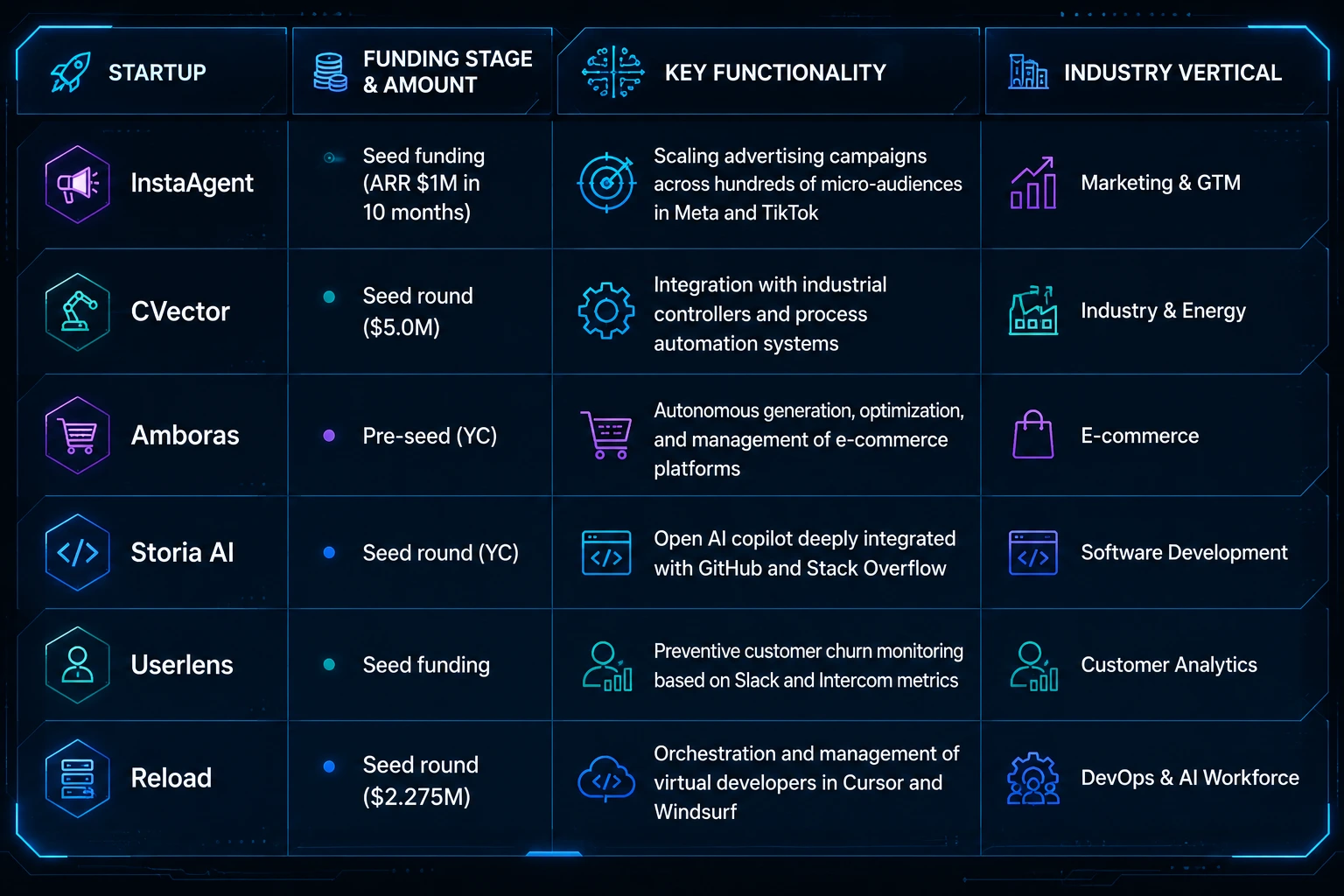
The AI agent ecosystem is rapidly filling with highly specialized solutions, many incubated within accelerators such as Y Combinator. These startups are focused on building defensible technological advantages through integration with proprietary databases and complex enterprise APIs.
Enterprise Infrastructure Agents and Data Analysis
A growing class of systems is emerging that can autonomously perform analytics directly within enterprise information environments. These projects address knowledge management challenges and oversee the functioning of the agentic systems themselves.
- Item: a platform that integrates enterprise communication tools and CRM systems into a unified contextual layer for training and coordinating autonomous AI agents.
- Datost: an autonomous data analyst equipped with its own virtual computer, capable of scanning code repositories, databases, Slack files, and internal documents to generate complex reports.
- Memory Store: a unified long-term memory layer for distributed AI teams, transforming Slack conversations and Claude sessions into structured contextual knowledge.
- Scope: a specialized “agent experience” (AX) audit service. The system tests how third-party agents such as Claude Code or Cursor interact with a vendor’s APIs and technical documentation, identifying scenarios in which AI buyers prefer competitors.
- Hyperspell: a memory infrastructure platform integrating Slack, Gmail, Notion, and Google Drive to coordinate multi-agent systems collaboratively.
Financial and Compliance Agents
The deployment of AI agents in financial transactions has required the development of strict software constraints and budget-control mechanisms.
- Custos: a system wrapping traditional payment infrastructure in programmable spending policies with real-time auditing, enabling secure delegation of financial transactions to AI agents.
- Solid: an infrastructure startup that raised $20 million to integrate agentic databases with Snowflake and Databricks analytical environments.
- Zerodrift: an enterprise communication firewall protecting email systems, CRMs, and browsers in financial institutions from unauthorized AI agent actions.
- Fenrock AI: specialized AI agents automating compliance procedures and regulatory policy processing for banks and fintech companies.
Vertical Industry Solutions
Deeply specialized vertical agents are achieving rapid adoption by understanding industry-specific standards and regulations.
- CVector: an advanced agentic system for managing physical infrastructure in industrial enterprises, chemical production facilities, and utility networks.
- Huscarl: an automated actuary assessing insurance risks for companies with revenues exceeding $50 million, reducing insurance premiums by up to 30%.
- Simplex: logistics web agents automating interactions with outdated freight carrier portals, invoice processing, and shipment coordination.
- ClaimGlide: a system automating prior authorization workflows for private healthcare clinics.
The Macroeconomics of AI Capital According to Goldman Sachs and Sequoia
The explosive growth of applied AI agents is taking place amid major debates regarding the return on investment (ROI) of AI infrastructure. Goldman Sachs analysts project that global spending on AI agents and supporting infrastructure will exceed $1 trillion in the coming years. In the United States alone, companies are already spending approximately $150 billion annually on the workforce required to support this technological transformation.
The Infrastructure Paradox and AGI Delays
Sequoia partner David Cahn describes 2026 as the “Year of Delays.” On the one hand, the construction timelines of major data centers are falling behind schedule due to shortages of electricity, networking equipment, and cooling infrastructure. On the other hand, expectations regarding the arrival of artificial general intelligence (AGI) are also being revised. The once widely shared Silicon Valley prediction of “AGI by 2027” had, by mid-2026, undergone a significant shift toward longer timelines.
Despite these delays, the pace of AI adoption and utilization among end users continues to grow exponentially. According to Goldman Sachs’ base-case model, annual AI capital expenditures (CapEx) are expected to reach $765 billion in 2026 and increase to $1.6 trillion by 2031. Cumulative AI-related CapEx over this period is projected to total $7.6 trillion. The largest spending category remains the replacement of GPUs - whose economic lifespan is estimated at only 4–6 years due to rapid technological obsolescence - alongside the construction of high-density, power-intensive data centers.
The Corporate ROI Dilemma
Goldman Sachs’ Head of Global Equity Research, James Covello, points to a fundamental imbalance in the market. Consumer adoption of conversational AI has been extraordinarily rapid, reaching 53% penetration within just three years. However, the overwhelming majority of users continue to rely on free versions of AI products. As a result, the economics of the entire AI industry increasingly depend on the willingness of enterprises to pay for automation. At the current stage, the primary financial beneficiaries are semiconductor manufacturers such as Nvidia and TSMC, while foundation model developers and hyperscalers continue to absorb significant operating losses.
According to Goldman Sachs’ analysis, direct savings from workforce reductions still do not justify the scale of corporate AI investments. Sustainable ROI models must instead focus on identifying new profit pools that can be automated. The greatest potential lies in sectors characterized by a high share of repetitive and routine operations:
- Autonomous trucking: by 2028, the cost per mile of autonomous freight transport in the United States is expected to fall below human labor costs, while the global market could reach $560 billion by 2035.
- Robotaxi services: the global commercial robotaxi market is projected to reach $415 billion by 2035, with fleet operators potentially achieving margins of 30–50%.
- Labor replacement and augmentation: in highly automatable roles such as billing clerks, insurance processors, and call-center operators, payroll costs are already declining rapidly. In contrast, professions requiring physical presence and unstructured analysis — such as executives, construction managers, and interior designers — are using AI as a cognitive amplifier that increases overall productivity and employment.
Architectural Shifts in Business According to McKinsey and Bain
Enterprise integration of AI agents requires moving beyond isolated chatbot implementations toward fundamental changes in operational models. McKinsey notes that while approximately 88% of organizations report experimenting with AI, 81% still do not observe significant impact on EBIT performance.
Consulting Services as an Adoption Catalyst
The primary obstacle to AI agent integration is the complexity of adapting infrastructure to legacy enterprise IT systems. This has led to the emergence of multibillion-dollar consulting alliances such as OpenAI DeployCo and Anthropic Services. These providers handle the “last mile” of implementation, including data connector setup, model orchestration systems, and workforce transformation management.
At the same time, the relationship between brands and consumers is evolving. Bain’s research on “Marketing in the Age of Agentic Commerce” shows that AI-generated traffic to retailer websites grew by 1200% by early 2026, increasing approximately 40% every month. In this environment, brands must become “machine-legible.” Instead of relying on emotional positioning, AI agents evaluate semantic website structure, catalog indexability, authentic reviews on external forums, and verified expert citations.
Developer Productivity and the Bottleneck Effect
According to Bain Technology Report findings, AI coding assistants deliver only modest local productivity improvements of approximately 10–15%. The core management mistake is focusing exclusively on code generation, which represents less than one quarter of the total software development lifecycle. Without optimizing adjacent stages - including architecture planning, compliance, security testing, and deployment - the productivity gains from AI coding are neutralized by bottlenecks. Moreover, uncontrolled use of AI by developers has resulted in a 51.3% increase in pull requests, a 54% rise in bug density, and an 861% increase in code churn. Only comprehensive restructuring of the entire SDLC enables stable efficiency improvements of 25–30%.
Practical Framework for Scaling Agentic Systems
To successfully deploy applied AI agents while minimizing security and operational risks, McKinsey recommends a systematic framework adapted to the challenges of 2026.
Step 1: Identify and Prioritize High-Impact End-to-End Processes
Organizations should avoid deploying isolated bots and instead focus on the “agentification” of complete business domains, such as customer onboarding, claims management, or dynamic pricing. Particularly promising are growth-oriented functions such as marketing and sales, where AI agents can generate revenue increases of 10–30% through hyper-personalization.
Step 2: Modernize IT Architecture for Agentic Requirements
It is recommended to follow seven core principles for restructuring enterprise data storage and processing platforms:
- Data Ingestion as a Product: Unification of batch, streaming, structured, and unstructured data ingestion through centralized data pipelines.
- Semantic Standardization: Mandatory assignment of shared metadata descriptions and definitions to all data, understandable both to analysts and autonomous models.
- Unified Data Foundation: Elimination of the separation between business intelligence (BI), traditional machine learning (ML), and generative AI environments.
- Integrated Security by Default: Automatic enforcement of access policies, personal data masking, and compliance checks directly at the data platform level.
- Stable API Interfaces: Providing AI agents with resilient and standardized interfaces for interacting with transactional systems.
- Full Observability: End-to-end logging of token costs, query execution accuracy, response latency, and incoming data quality.
- Coordinated Orchestration Layer: Routing tasks based on complexity. Simple, repetitive operations should be handled by small local models (SLMs) with low computational costs, while expensive frontier models such as Claude or GPT should be reserved exclusively for solving unstructured cognitive tasks.
Step 3: Establish Continuous Quality Control
Organizations must shift from periodic data cleaning toward real-time quality monitoring. This is critical because AI agents tend to accumulate cascading errors during long multi-step autonomous workflows.
Step 4: Deploying an Operational Trust and Compliance Model (Responsible AI)
McKinsey’s AI Trust Maturity Survey shows that risk profiles are shifting. In the era of applied AI agents, the main concern is no longer hallucinated text, but unauthorized actions such as accidental payments, database corruption, or unintended customer communications. Approximately 64% of corporate leaders identify security risks as the primary reason for pausing agentic AI pilots.
Organizations must implement a strict access control and sandboxing framework for AI agents, alongside mandatory Human-in-the-Loop approval procedures for high-risk operations such as payment authorization, price changes, or the sending of transactional communications. In this new operating model, the role of humans evolves from direct task execution toward supervision and orchestration of distributed agentic ecosystems.
Works cited
1. The 2026 State of AI Agents Report - jsDelivr, https://cdn.jsdelivr.net/gh/abncharts/abncharts.public.1/abnasia.org/1765455980320_www.abnasia.org.pdf
2. Scaling agentic AI with data transformations | McKinsey, https://www.mckinsey.com/capabilities/mckinsey-technology/our-insights/building-the-foundations-for-agentic-ai-at-scale
3. 7 AI Agent Startups Funded by Top VCs in 2026 - Unicorn Screener, https://unicornscreener.vc/blog/7-ai-agent-startups-funded-by-top-vcs-in-2026
4. AI Agents Market Size And Share | Industry Report, 2033 - Grand View Research, https://www.grandviewresearch.com/industry-analysis/ai-agents-market-report
5. AI Agents Market Report 2026, https://www.researchandmarkets.com/reports/6103459/ai-agents-market-report
6. AI Market Statistics 2026: Size, Growth & Investment, https://sqmagazine.co.uk/ai-market-statistics/
7. Cursor $2B Funding Round at $50B Valuation | Anysphere AI - Let's Data Science, https://letsdatascience.com/blog/cursor-2-billion-funding-round-50-billion-valuation
8. Cursor (company) - Wikipedia, https://en.wikipedia.org/wiki/Cursor_(company)
9. Cursor to raise $2B from Andreessen Horowitz and Thrive Capital at a $50B valuation: report — TFN - Tech Funding News, https://techfundingnews.com/cursor-anysphere-2b-funding-50b-valuation-ai-coding/
10. SpaceX Strikes Potential $60B Deal to Acquire AI Startup Cursor - eWeek, https://www.eweek.com/news/spacex-cursor-partnership-anysphere-acquisition-ai-coding/
11. Lovable Statistics 2026: Users, Revenue & Adoption Data - Panto AI, https://www.getpanto.ai/blog/lovable-statistics
12. Swedish AI startup Lovable valued at $6.6 billion in latest funding round - CNBC, https://uk.investing.com/news/company-news/swedish-ai-startup-lovable-valued-at-66-billion-in-latest-funding-round--cnbc-93CH-4420317
13. Lovable Revenue 2025: $200M ARR, $6.6B Valuation - GetLatka, https://getlatka.com/companies/lovable.dev
14. Lovable raises $330M to power the age of the builder, https://lovable.dev/blog/series-b
15. Top AI Agent Startups 2026 (Funding & Valuation), https://aifundingtracker.com/top-ai-agent-startups/
16. Generative AI Startups funded by Y Combinator (YC) 2026, https://www.ycombinator.com/companies/industry/generative-ai
17. AI Assistant Startups funded by Y Combinator (YC) 2026, https://www.ycombinator.com/companies/industry/ai-assistant
18. AI Agent Startup List - Scouts by Yutori, https://scouts.yutori.com/1541d913-0ea9-42b9-8e62-652ddab20126
19. How do business really use their AI Agents? Are these startups even in the right direction?, https://www.reddit.com/r/AI_Agents/comments/1t5kgz6/how_do_business_really_use_their_ai_agents_are/
20. Four student-founded AI companies win Cornell Tech Startup Awards, https://news.cornell.edu/stories/2026/05/four-student-founded-ai-companies-win-cornell-tech-startup-awards
21. Will the Corporate Investment in AI Pay Off? | Goldman Sachs, https://www.goldmansachs.com/insights/articles/will-the-corporate-investment-in-ai-pay-off
22. Goldman predicts AI agent investments to exceed $1 trillion globally By Investing.com, https://www.investing.com/news/stock-market-news/goldman-predicts-ai-agent-investments-to-exceed-1-trillion-globally-93CH-4679320
23. AI in 2026: A Tale of Two AIs | Sequoia Capital, https://sequoiacap.com/article/ai-in-2026-the-tale-of-two-ais/
24. Tracking Trillions: The Assumptions Shaping the Scale of the AI Build-Out | Goldman Sachs, https://www.goldmansachs.com/insights/articles/tracking-trillions-the-assumptions-shaping-scale-of-the-ai-build-out
25. Agents for growth: Turning AI promise into impact - McKinsey, https://www.mckinsey.com/capabilities/growth-marketing-and-sales/our-insights/agents-for-growth-turning-ai-promise-into-impact
26. The State of Organizations 2026 | McKinsey, https://www.mckinsey.com/~/media/mckinsey/business%20functions/people%20and%20organizational%20performance/our%
20insights/the%20state%20of%20organizations/2026/the-state-of-organizations-2026.pdf
27. OpenAI Debuts $4B AI Services Company As Rival Anthropic Builds Its Own - CRN, https://www.crn.com/news/ai/2026/openai-launches-services-business-on-heels-of-similar-anthropic-announcement
28. Artificial Intelligence Insights | Bain & Company, https://www.bain.com/insights/topics/ai/
29. Marketing's New Middleman: AI Agents | Bain & Company, https://www.bain.com/insights/marketings-new-middleman-ai-agents/
30. Rewiring Demand Generation in the Age of AI Agents | Bain & Company, https://www.bain.com/insights/rewiring-demand-generation-in-age-of-AI-agents/
31. Bain Technology Report 2025: Why AI Gains Are Stalling - Faros AI, https://www.faros.ai/blog/bain-technology-report-2025-why-ai-gains-are-stalling
32. Reinventing marketing workflows with agentic AI - McKinsey, https://www.mckinsey.com/capabilities/growth-marketing-and-sales/our-insights/reinventing-marketing-workflows-with-agentic-ai
33. State of AI trust in 2026: Shifting to the agentic era - McKinsey, https://www.mckinsey.com/capabilities/tech-and-ai/our-insights/tech-forward/state-of-ai-trust-in-2026-shifting-to-the-agentic-era
Never miss an insight. We'll email you when new articles are published on this topic.


Bring your toughest pricing questions?
Our experts will help you find the best solution for your needs.